Advanced Grant Writing Course with Federal Grant Training
- ✓ All six core units plus four advanced units
- ✓ Federal applications, private funders, and the system for reviewing and submitting
- ✓ Simple online exam with a 99% pass rate
- ✓ 30-day money-back guarantee
- ✓ Flexible, self-paced online learning with lifetime access
- ✓ Instant access to course materials
- ✓ Priced in USD
Course last updated: September 2026
Every certificate carries a verification id, so an employer or a client can confirm it themselves on our verification page. What a graduate has to do to earn one is set out in our certification standards.
Here's what you'll learn in our Advanced Grant Writing Course
Introduction to Grant Writing
- Understanding how the grant funding landscape works
- Exploring the different types of funders and what motivates them
- Learning what funders expect from professional grant writers
- Overview of the grant process from start to finish
- Setting yourself up for a successful grant writing journey

Finding the Right Funding Opportunities
- Conducting effective funder research using proven methods
- Evaluating whether an opportunity is worth pursuing
- Understanding funder priorities and how to align with them
- Building and organizing a prospect pipeline
- Knowing when to apply and when to walk away

Understanding Proposal Structure
- Breaking down the anatomy of a winning grant proposal
- Learning the purpose and flow of each core section
- Understanding how reviewers evaluate applications
- Recognizing common structural mistakes to avoid
- Adapting your approach for different formats and funders

Writing Compelling Narratives
- Crafting problem statements that demand attention
- Developing clear, outcomes-focused goals and objectives
- Describing your approach with clarity and confidence
- Demonstrating organizational credibility and capacity
- Balancing data with storytelling for maximum impact

Budgets and Supporting Materials
- Building budgets that are accurate, realistic, and persuasive
- Understanding common budget categories and terminology
- Creating timelines and work plans that inspire confidence
- Preparing strong supporting documents and attachments
- Ensuring consistency across all proposal components

Logic Models and Evaluation
- Understanding why funders prioritize measurement and outcomes
- Building logic models that clearly connect activities to impact
- Designing evaluation plans that satisfy funder requirements
- Communicating your approach to tracking success
- Using evaluation strategically to strengthen your proposals

Federal Grants Decoded
- Demystifying the federal grant application process
- Navigating registration, compliance, and formatting requirements
- Breaking down complex funding announcements quickly
- Shortcuts for tackling lengthy government applications
- The five column compliance matrix that replaces rereading the notice

Foundation and Corporate Funding
- Understanding what private funders look for and how they differ
- Writing letters of inquiry that get responses
- Tailoring your approach for foundations and corporate giving
- Building funder relationships that lead to repeat funding
- The seven private funder documents worth writing once, and what each one says

The Review and Submission System
- A streamlined process for editing and polishing proposals
- Catching errors and strengthening weak spots quickly
- Final compliance checks before you hit submit
- Managing deadlines and submission portals with confidence
- What to do in the week after you submit, and how to read a decline

Launching Your Grant Writing Career
- Positioning yourself for roles or freelance opportunities
- Setting rates and structuring client relationships
- Managing multiple projects without dropping the ball
- Marketing yourself as a credible grant writing professional
- The six documents a practice runs on, and the two to write this afternoon
- Working inside the ethics codes the field already publishes

How federal grant applications work, and where this course teaches them
Federal funding is the part of grant writing with the most rules written down, which is exactly what makes it learnable. Unit 7, Federal Grants Decoded, is the unit in this course built around it. What follows is the short version of the order a federal application moves in, so you can see what the unit trains before you enroll.
Register in SAM.gov well before you need it
An organization applying for a federal grant must first register as an entity in SAM.gov, the System for Award Management. Registration is free, and it assigns the organization a Unique Entity ID (UEI), which Grants.gov then places on every application automatically. The UEI replaced the older DUNS number, a transition federal agencies completed by April 4, 2022.
Grants.gov advises allowing up to 10 business days for a SAM.gov registration to become active even when the organization's details are in order, and warns that it can take weeks or months when information cannot be verified. The registration must be renewed every year. That is why Unit 7 treats registration as something to finish before an announcement appears, not in the week you find one.
Set up Grants.gov and the roles behind the submit button
Once SAM.gov is done, the organization's Electronic Business Point of Contact creates a Grants.gov account with the same email address used in SAM.gov, then adds an organization applicant profile using the UEI. Every Grants.gov user also needs a Login.gov account. The point of contact assigns roles to everyone else, and only someone holding an Authorized Organization Representative (AOR) role, or a custom role with submit privileges, can sign and submit.
A consultant does not need the client's credentials. They register their own Grants.gov account and the organization adds them to the application's workspace as a participant, which is the route a freelance grant writer takes on federal work.
Read the Notice of Funding Opportunity before you write
Every federal competition is published as a Notice of Funding Opportunity, or NOFO, which the Grants.gov glossary also calls a funding opportunity announcement. It holds everything an applicant needs to judge eligibility and fit, along with the agency's own instructions, including file naming rules that take precedence over the Grants.gov defaults.
Grants.gov describes the review that follows in stages. An initial screening checks that the application is complete, then come a programmatic review of the substance, a financial review of the proposed budget, and the award decision. Unit 7 teaches a reading order for a long notice and a five-column compliance matrix that turns every requirement into a row someone owns, so an application is never lost at the screening stage.
Know the standard forms
Federal application packages are built from the government-wide SF-424 form families. The core form is the SF-424, the Application for Federal Assistance, which carries the organization's details and its UEI. Packages for non-construction projects often include the SF-424A, Budget Information for Non-Construction Programs, and the SF-LLL, Disclosure of Lobbying Activities, is where lobbying is declared. The agency decides the exact set for each opportunity, and the workspace lists the forms that one requires.
Treat the deadline as earlier than it is
Grants.gov advises submitting well before the deadline in case a submission error occurs. The Sign and Submit button only becomes available when the forms have passed the application check, the organization's SAM.gov registration is active, and the deadline has not passed. Attachments can sink an application too. Grants.gov limits file names to 50 characters and warns that unsupported special characters can get an application rejected.
After you submit, the Check Application Status page shows where it stands, with statuses such as Validated and Received by Agency. The agency notifies you once its own process is complete.
Where this fits with the rest of the course
Federal work applies the same proposal method as every other application, under stricter rules. The general method, from need statement to budget, is laid out in our guide on how to write a grant proposal. A note on the word certification. Grant writing has no government license in the United States, so the credential this course leads to is the Institute's own C.G.W.P., and the federal training inside it is Unit 7.
Keep a grants calendar full and still submit every proposal clean
10 units and one exam. The four units past Professional cover federal applications in Unit 7, Federal Grants Decoded, private funders in Unit 8, the review and submission system in Unit 9, and in Unit 10 the rates, scope and working method that let you run several deadlines at once.
Enroll now ($498)
Quick and easy online exam
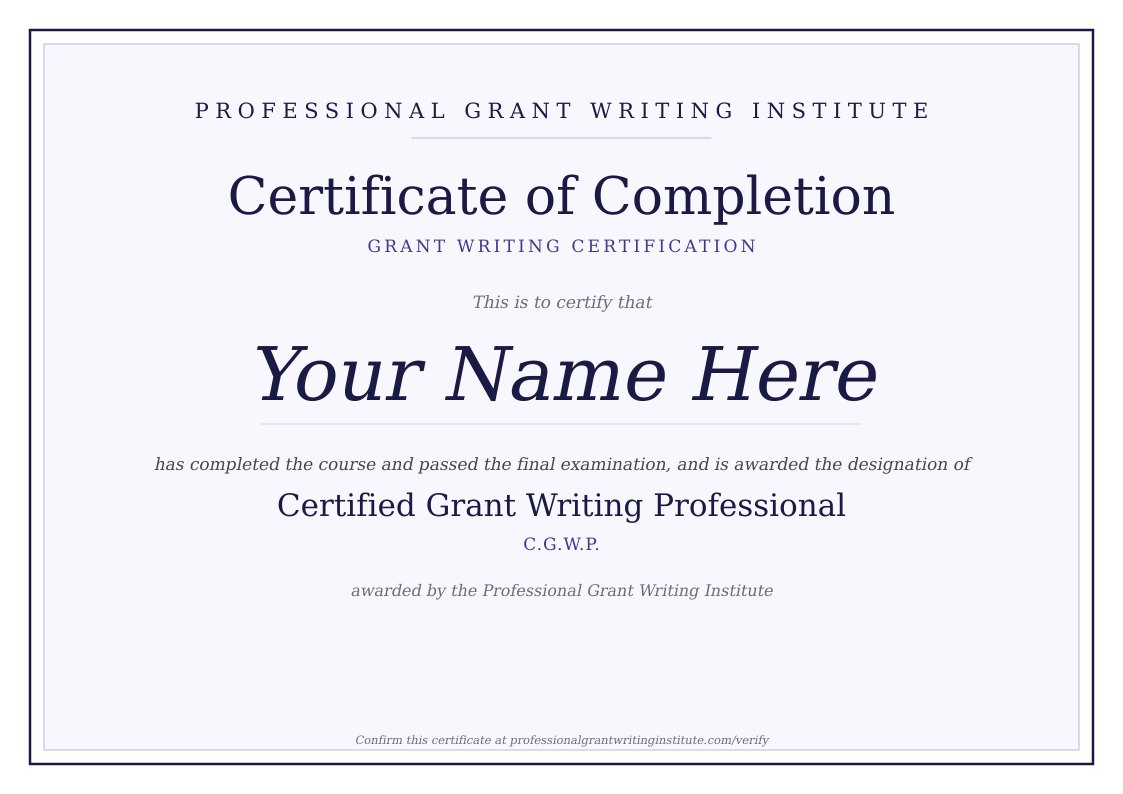
When you finish the training you take a short, open-book online exam with a 99% pass rate. Pass it and you earn your Grant Writing Certification as a Certified Grant Writing Professional (C.G.W.P.), on a certificate that carries a verification ID anyone can check.
Advanced Grant Writing Course summary
For those who want to go beyond writing a proposal and build a career on it, including federal work. No prior experience is required.
Everything in the Professional Grant Writing Course plus four additional units on federal grants, foundation and corporate funding, review and submission, and launching your grant writing career. Expect to add one to two weeks to the standard timeline, depending on your pace.
$498 for lifetime access.
Students who started where you are
Reviews are collected from students across our suite of educational brands.

Get started, risk free.
If you don't feel ready to write winning grant proposals after completing our training, we'll give you your money back. Just email us within 30 days and we'll refund the full cost. Guaranteed.